An AI scientist to create a virtuous nurture loop
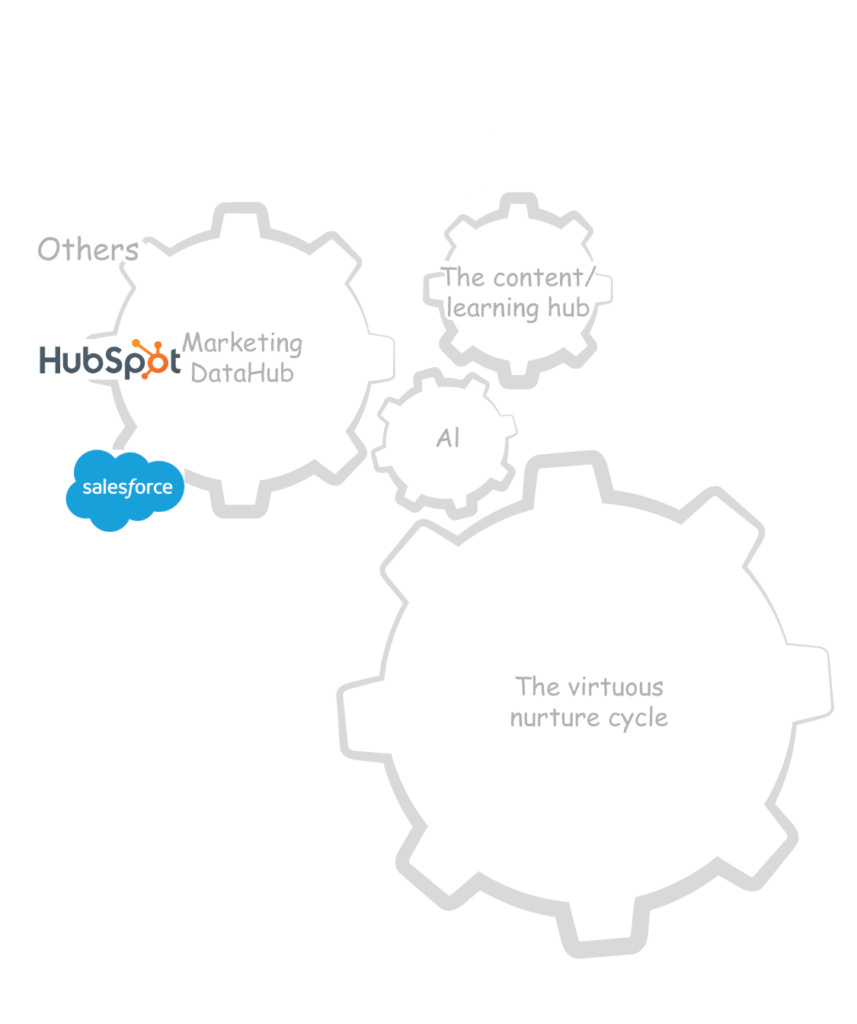
The biggest losses happen in the seams.
Where in the revenue chain
can AI create the greatest impact?
I spent years at the intersection of product, sales, and engineering. Trained as an industrial engineer. Tested in enterprise sales. Refined through product leadership at SAP, where I watched an SMS service become an intelligent, API-led platform that transformed customer acquisition at scale.
That career taught me one thing above all else: the biggest losses in any system don’t happen at the edges — they happen in the seams. In manufacturing, you find waste where one process hands off to the next. In revenue marketing, it’s exactly the same.
The waste isn’t in your top-of-funnel spend or your sales team’s close rate. It’s in the seam between them — the middle, where demand goes to die quietly.
92% of GTM leaders can’t measure
their nurture contribution.
I started talking to marketing leaders — not about their tools or their tech stack, but about where the system was failing them. The answer kept coming back the same way. Leads. Sequences. CRMs full of contacts who had expressed intent — attended an event, taken a demo, clicked a campaign — and then gone silent.
Nobody had a structured way to do anything about it.
Not poor. Not improving. Unknown. They couldn’t measure it, couldn’t defend it, couldn’t connect it to pipeline. The biggest item in the marketing motion with the least accountability attached to it.
This isn’t a content problem. It isn’t a tooling problem. It’s a systems problem. And structural problems need structural solutions.
Map the value stream.
Find the process losses.
Mapping a conversion journey as a value stream and hunting for process losses is classic industrial engineering. I applied it to marketing operations and found the same pattern every time.
The seam between marketing and sales is where context is lost. Where a lead that expressed genuine intent three months ago sits in a CRM with no signal, no score, and no next step. Where the ideal customer profile is built from last year’s wins. Where data from four systems means four different definitions of ARR — and the revenue meeting starts with twenty minutes of reconciliation before any decision is made.
A system that listens, learns,
and adapts. Continuously.
The insight that seeded Logloop: what if, instead of static drip campaigns and assumptions about buyer behaviour, the system could listen to first-party signals — on your own channels, from contacts who have already expressed intent in your ecosystem?
A contact who registered for your webinar and attended is telling you something. A contact who engaged with three pieces of content and then went quiet is telling you something different. A customer who converted, used the product for six months, and churned is telling you the most important thing — that the profile you used to acquire them needs to subtract their attributes before the next campaign runs.
The virtuous nurture cycle reads all of those signals continuously, scores them against what actually drives expansion revenue, and routes the right action to the right team — without a human having to interpret a spreadsheet to decide what to do next.
You can’t build an adaptive system
on fragmented data.
Marketing calls it an MQL. Sales calls it a lead. CS calls it an account. Finance calls it ARR. Four teams, four systems, four definitions — and a seam between each one where context is lost and decisions are made on incomplete pictures.
With the team at Loglens Labs, we built the GTM Data Hub to close that seam at the data layer — a managed hub that deploys inside your VPC. An agentic data dictionary that monitors field definitions and surfaces conflicts before they corrupt a month of reports. A transformation layer that joins signals from CRM, marketing automation, product telemetry, and your data warehouse into a single unified model.
The only thing that crosses your boundary is the insight. Not the underlying record. The score, the flag, the trigger — written back to your CRM as a native property every team acts on.
One seam closed at a time.
Every revenue team has the same three gaps between them and the pipeline they should be generating.
AI is being applied to the edges.
The seam stays broken.
AI is generating content, summarising calls, drafting sequences. These are valuable. But they optimise the edges while the seam stays broken. The contacts already in your CRM who aren’t being reached. The leads being scored with a profile built from stale data. The revenue conversations happening without a shared definition of what any number means.
Logloop puts an agent in each seam. Not to replace the humans who own these motions — but to give them the signal, the context, and the evidence they need to act confidently.
AI assisted. Human finalized. That’s the system. That’s what we’re building.
Gokul Anantha
Founder, Logloop · LinkedIn · hello@logloop-ai.com
Building AI agents for the seams between revenue teams. logloop-ai.com